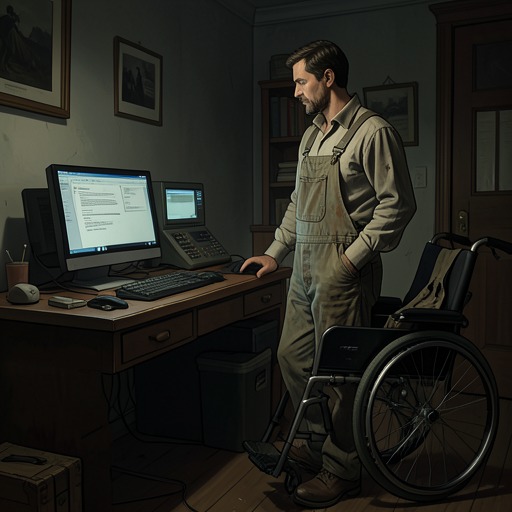
“I’m going to kill you. You won’t see me coming.”
Mr. Mercedes“I’m going to kill you. You won’t see me coming.” is Brady Hartsfield’s escalating threat to K. William Hodges, first introduced in an earlier, less explicit message and later repeated as a promise of murder. Its recurrence links Brady’s private preparations and public taunts to the bombing of Hodges’s car outside Soames Funeral Home, while its final echo in Hodges’s mind turns a boast about unseen violence into the rhythm of the scene’s aftermath.
First Message and Escalation
The threat begins in a shorter, more abusive form. After leaving Hodges a one-sentence message, Brady returns to video games until his mother calls him to dinner. Later, with her asleep, he prepares poisoned food for Odell, the dog. The message and the attempted poisoning are distinct parts of Brady’s conduct, but both belong to the same effort to reach Hodges: Brady has bought the poison not simply to harm the dog, but as a way to get to the retired cop and unsettle him.
K. William Hodges encounters that initial message on Janey Patterson’s iPad while browsing Debbie’s Blue Umbrella. He responds with a laugh, surprising himself, but Janey does not share his amusement. The contrast marks the message’s double function: Hodges can momentarily treat it as bluster, while the people close to him see the threat as something not to dismiss.
After regaining control of himself, Brady uses voice commands successfully at his Number Three computer and logs on to Debbie’s Blue Umbrella. This time, the message is explicit: “I’m going to kill you. You won’t see me coming.” The change from “I’m going to fuck you up, Grampa” to a direct declaration of murder gives the phrase its defining form and raises the stakes of Brady’s online antagonism.
Repetition and Preparation
The threat returns when Brady reads the funeral arrangements for Elizabeth Wharton. He considers whether Hodges will attend the visitation, memorial service, and reception, reasoning that the retired policeman will be looking for him. Brady remembers the message he sent and says its concluding warning aloud. The phrase is no longer just a line typed into a computer: he carries it into his planning for a place and occasion where he expects Hodges to appear.
In this context, the words perform two functions. They announce Brady’s intention, but they also help him cast the coming encounter as proof that he can control what Hodges sees and when. His confidence depends on remaining unseen; the threat’s repetition turns that idea into a personal challenge directed at his opponent.
The Funeral-Home Bombing
Brady watches cars leave Soames Funeral Home, expecting traffic heading toward Sugar Heights. Hodges’s Toyota appears at the head of the driveway and turns toward him. Brady notices the driver’s familiar hat but sees no one else in the car, and briefly feels disappointed that the blond woman is not with Hodges. He then keys in a number, repeats that Hodges will not see him coming, and presses SEND.
The car explodes. Holly Gibney and Hodges run toward the scene as bystanders react in confusion and alarm. Hodges’s Toyota has been blown off its axles and is burning; part of the back seat lies some distance away. In the immediate aftermath, Hodges thinks that the bombing is his fault and connects the danger to an earlier decision not to use his father’s gun. The threat’s promised surprise has become a real attack with consequences for the people around Hodges, not merely another exchange between adversaries.
The Threat as a Recurring Motif
As Hodges pursues the fleeing attacker, Brady’s last message repeats in his mind: “I’m going to kill you. You won’t see me coming.” The narrative brings the phrase back at the point when the unseen threat has produced visible destruction. The repetition makes the message a mental refrain, joining the earlier online exchanges to Hodges’s urgent pursuit and his sudden recognition of what has happened to his car.
The phrase’s force rests on the gap between Brady’s claim and the result he can control. He can send a warning and arrange an attack that catches Hodges by surprise, but the message cannot secure the outcome he imagines for himself. At the funeral home, its final use is both a taunt and a declaration of intent; in the aftermath, its echo becomes part of Hodges’s confrontation with the cost of failing to stop the violence. The expression therefore marks the escalation of Brady’s campaign while carrying the irony that a threat designed to make Hodges look for an unseen killer cannot make its sender invulnerable.